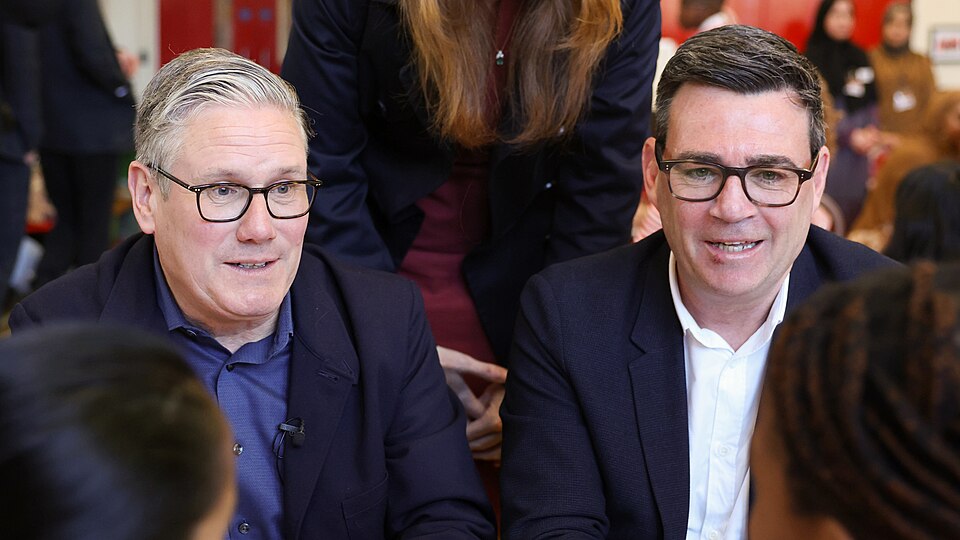
Andy Burnham has made one of the biggest constitutional reforms in decades a defining ambition of his premiership, arguing that shifting power away from Westminster is essential to
narrowing Britain's long-standing regional inequalities.
The prime minister has pledged what he describes as the largest transfer of power from central government in modern British history, giving regional leaders greater control over areas including transport, housing, skills, economic development and public spending.
Supporters say the changes could help rebalance an economy that has long been dominated by London and the South East. Critics, however, warn that delivering such an overhaul will be politically difficult, administratively complex and unlikely to produce results before the next general election.
A highly centralised system
The UK remains one of the most centralised developed economies when it comes to taxation and public spending. According to the Organisation for Economic Co-operation and Development (OECD), only around 6% of tax revenue is raised below national government level, compared with roughly 20% in France and around half in Germany and the United States.
Many economists argue that this concentration of power has contributed to some of the widest regional economic disparities in Europe. Income and productivity gaps between parts of England exceed those seen between eastern and western Germany or northern and southern Italy.
Supporters of devolution argue that allowing local leaders greater control over revenues and investment decisions would give regions stronger incentives to attract businesses, improve infrastructure and grow their economies.
More than transferring powers
Experts caution that devolving responsibilities alone will not be enough.
Marcus Johns, a senior researcher at the Fabian Society, says stronger systems of local accountability will be essential if reforms are to succeed. He argues that regional institutions need greater scrutiny powers, while local accounting officers should have clearer legal responsibilities over how public money is managed.
The challenge is significant. Only a small proportion of local authorities produced fully audited accounts for the 2024–25 financial year, contributing to the government's spending watchdog declining for a third consecutive year to sign off the UK's Whole of Government Accounts.
Henri Murison, chief executive of the Northern Powerhouse Partnership, says expectations will also have to be managed.
"If you talk a good game, but don't actually pass any of the power on, or it happens very slowly, people get impatient and get frustrated by it," he says.
Lessons from previous reforms
Successive governments have promised to reduce regional inequalities through decentralisation.
Over the past three decades, devolved governments have been established in Scotland, Wales and Northern Ireland, while elected mayors have been introduced across several English city regions. Burnham himself previously served as Mayor of Greater Manchester.
His government is expected to focus primarily on England, home to around 85% of the UK's population, while also considering additional powers for the devolved administrations elsewhere in the UK.
However, evidence from earlier rounds of devolution presents a mixed picture. Scotland, Wales and Northern Ireland have all remained among the slower-growing parts of the UK economy since the late 1990s.
Leaders in those nations argue they still lack sufficient tax-raising and borrowing powers to shape long-term economic growth.
Akash Paun, programme director for devolution at the Institute for Government, says Burnham's experience in Greater Manchester gives him a practical understanding of regional government, but warns that reform is unlikely to happen evenly across England.
"He might find there's less low-hanging fruit than he would hope," he says. "You need institutions, leaders and capacity able to exercise those functions appropriately."
Political risks
Burnham has proposed opening a prime ministerial office in Manchester, describing it as the "nerve centre" of a more decentralised Britain. But the symbolic move will ultimately be judged against whether significant powers and funding are transferred out of Whitehall.
Previous governments have struggled to achieve similar ambitions. David Cameron promoted the "Northern Powerhouse" agenda and introduced elected metro mayors, while Boris Johnson's "Levelling Up" programme sought to reduce regional inequality but stopped short of major constitutional reform.
Whitehall departments, particularly the Treasury, have historically been reluctant to surrender control over spending decisions, especially where concerns remain about local financial oversight.
Some economists also question whether devolution alone can deliver stronger economic growth, while acknowledging that restructuring government would involve significant costs.
Burnham's plans will also compete with more immediate demands on government, including pressure on public finances, sluggish economic growth and international challenges.
Former Conservative prime minister Rishi Sunak has argued that wider events could limit the government's ambitions, writing that Burnham "may want to be the 'devolution PM', but the world will have other ideas."
Whether Burnham's reforms become a lasting constitutional shift or another attempt to rebalance Britain that falls short may depend not only on political will, but also on how quickly regional institutions can demonstrate they are ready to take on greater responsibility. Photo by Number 10, Wikimedia commons.