Responding to the government’s new national strategy on homelessness, Cllr Grace Williams, London Councils’ Executive Member for Housing & Regeneration, said:
“London is grappling with the most severe homelessness emergency in the country. We estimate one in 50 Londoners currently live in temporary accommodation, with at least one homeless child in every London classroom.
“Boroughs welcome this new national strategy from the government. We are particularly pleased that the strategy takes a cross-departmental approach, acknowledges the urgent need to get homeless families out of inappropriate temporary accommodation, and brings a much-needed funding boost for homelessness services.
“Reversing the rising tide of homelessness should certainly be a national priority and will not happen overnight. Further action will be needed and we remain extremely concerned about the unsustainable pressures on London boroughs’ temporary accommodation resources. We will continue to highlight the challenges in the capital and work with ministers on tackling this crisis.”
London’s local authorities have issued a stark warning over the scale of homelessness in the capital, as new figures show more than half of all homeless households in England are now based in the city.
According to London Councils, around 180,000 Londoners — roughly one in every 50 residents — are homeless and living in temporary accommodation. The crisis is particularly acute for children: one in 21 is without a permanent home, meaning every classroom in London is likely to include at least one homeless pupil. Meanwhile, more than 330,000 households remain on social housing waiting lists.
The cross-party body, representing all 32 boroughs and the City of London, said the situation is inflicting “devastating” effects on individuals while placing unprecedented strain on local services. Boroughs are now spending a combined £5.5 million a day on homelessness support.
Despite the pressures, London Councils said it is committed to working with ministers on solutions. Borough leaders welcomed several recent government moves — including the extension of the Local Authority Housing Fund, an uplift to the Homelessness Prevention Grant, and up to £11.7 billion of planned investment in affordable housebuilding through the next decade.
The organisation has also partnered with the Mayor of London on a new Ending Homelessness Accelerator Programme, which has secured government funding aimed at speeding up progress.
However, London Councils stressed that further reforms are essential if homelessness is to be reduced at scale. Its key asks include:
A modernised subsidy for temporary accommodation.
The welfare payment used to subsidise temporary accommodation has been frozen since 2011, despite steep rises in housing costs. Boroughs say this gap forces them to rely on lower-quality, often distant properties, worsening outcomes for families and undermining council finances. Increasing the subsidy to reflect today’s market, they argue, is critical.
Higher Local Housing Allowance (LHA) rates.
Rising private rents mean many low-income Londoners cannot secure housing within current LHA limits, pushing more people into homelessness. London Councils is calling for LHA rates to be raised across the board.
Additional capital funding to build or buy homes.
Boroughs want expanded investment to acquire or construct properties, reducing reliance on the volatile private rented sector and improving both the quality and long-term value of temporary accommodation.
Measures to stabilise social housing finances.
With council housing budgets under severe pressure, boroughs warn they are being forced to consider cutbacks just as demand surges. They are urging ministers to use the upcoming social rent policy decision to support the sector, including setting a rent convergence rate of at least £3 per week from April 2026 to help ensure fair funding and enable the expansion of social housing.
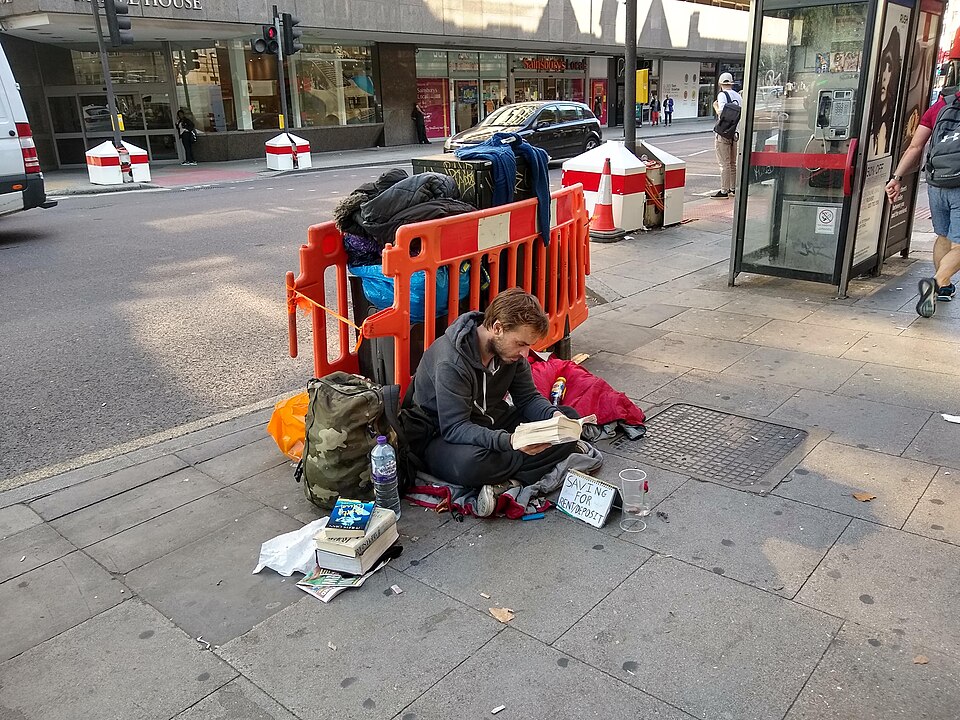
London Councils said that without decisive action, the capital’s homelessness emergency will continue to escalate, deepening inequalities and placing further financial burdens on already stretched local authorities. Photo by Philafrenzy, Wikimedia commons.