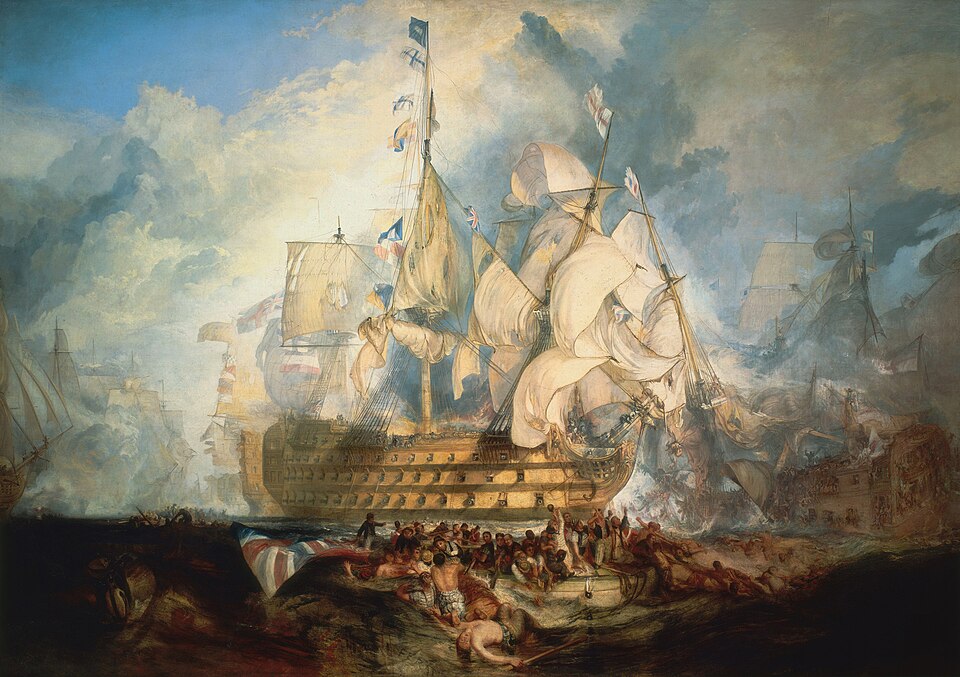
A rare Union Flag that led the British charge at the Battle of Trafalgar has been placed under an export bar, giving UK institutions the chance to keep the historic relic in the country.
The flag, which flew from the Royal Sovereign—the first ship to engage French and Spanish forces during the 1805 battle—still bears burn marks and splinter damage from the fierce fighting that claimed 4,500 lives, including Admiral Horatio Nelson himself. Valued at £450,000, it offers a tangible link to one of Britain’s defining military victories.
The Battle of Trafalgar, fought off the coast of southern Spain during the Napoleonic Wars, saw Nelson’s outnumbered fleet execute a daring attack that prevented the French from reinforcing their positions in Italy. The Royal Sovereign, carrying the now-famous flag, spearheaded the assault as part of Nelson’s bold manoeuvre to split the enemy line.
Constructed from hand-stitched wool bunting and maintained by the ship’s sailors, the flag is thought to be one of only three surviving from that historic day. Its scars serve as a stark testament to the chaos and intensity of naval combat, as well as Nelson’s tactical brilliance.
Culture Minister, Baroness Twycross said: “Few symbols in our country are as evocative as the Union Flag, and this flag in particular is an extraordinary representation of Britain’s history and national identity.
This flag was made by ordinary Britons and now epitomises a defining moment in our national history. I hope this profoundly important historical artefact can remain in Britain for the public to enjoy”.
Pippa Shirley, Committee member said: “The Battle of Trafalgar has a uniquely important and defining place in our perception of British history and nationhood. This flag, which flew high above the fleets as they clashed on that momentous day, is one of only three to survive. It transports us to the heart of events as a physical witness, battle-scarred but astonishingly intact, to Nelson’s tactical genius and the chaos, ferocity and drama of close combat at sea. The Royal Sovereign, flagship of Vice-Admiral Collingwood, played a vital role alongside Victory herself as the first ship into action leading one of the two columns deployed by Nelson in his boldly innovative, and successful, manoeuvre to split the line and which engaged and disabled the larger Spanish flagship. It was also the first time that Nelson ordered all ships to fly a Union Jack so that the British fleet could tell friend from foe in the smoke and noise of the battle. The flag’s evocative connection to our national life and the establishment of the long period of British naval dominance runs so deep that its departure would be a great loss”.
The export bar, recommended by the Reviewing Committee on the Export of Works of Art and Objects of Cultural Interest, will remain in place until 16 March 2026. During this time, UK galleries or institutions can make an offer to purchase the flag at its £450,000 valuation, plus £90,000 VAT, potentially reclaimable by eligible buyers. Photo by Royal Museums Greenwich, Wikimedia commons.